Come Again a Bit, Freddy
The Source of the Song in Anne Lister's Journal
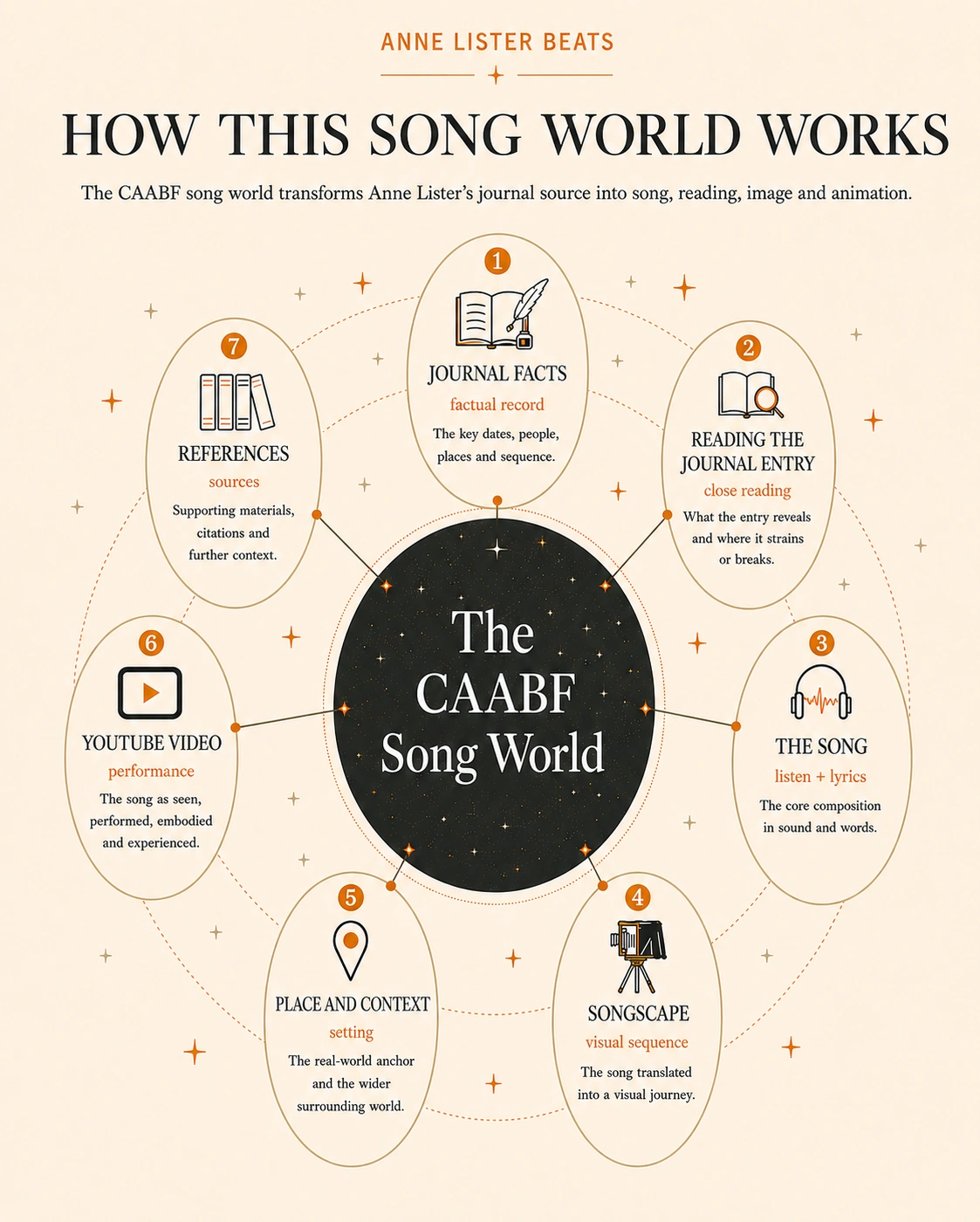
How This Song World Works
Journal Facts
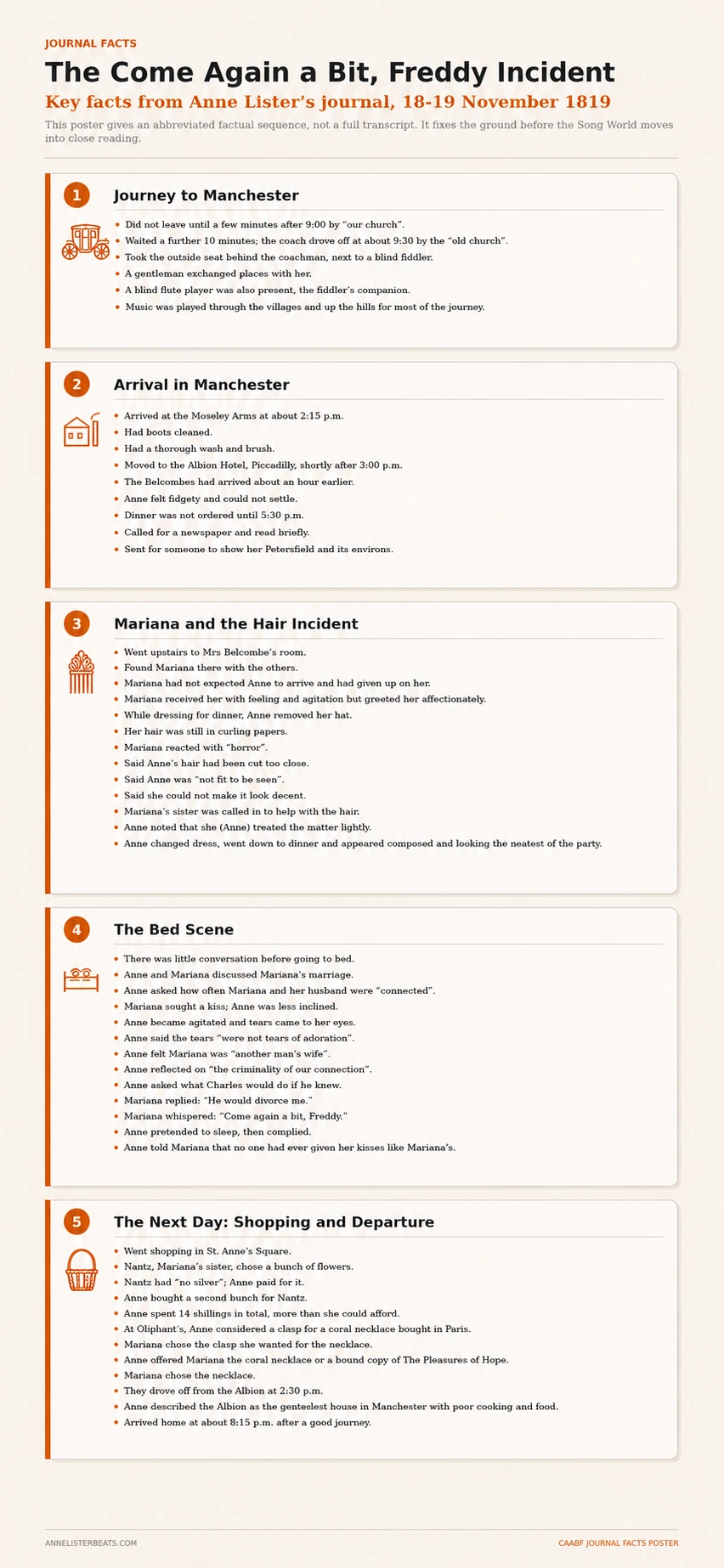
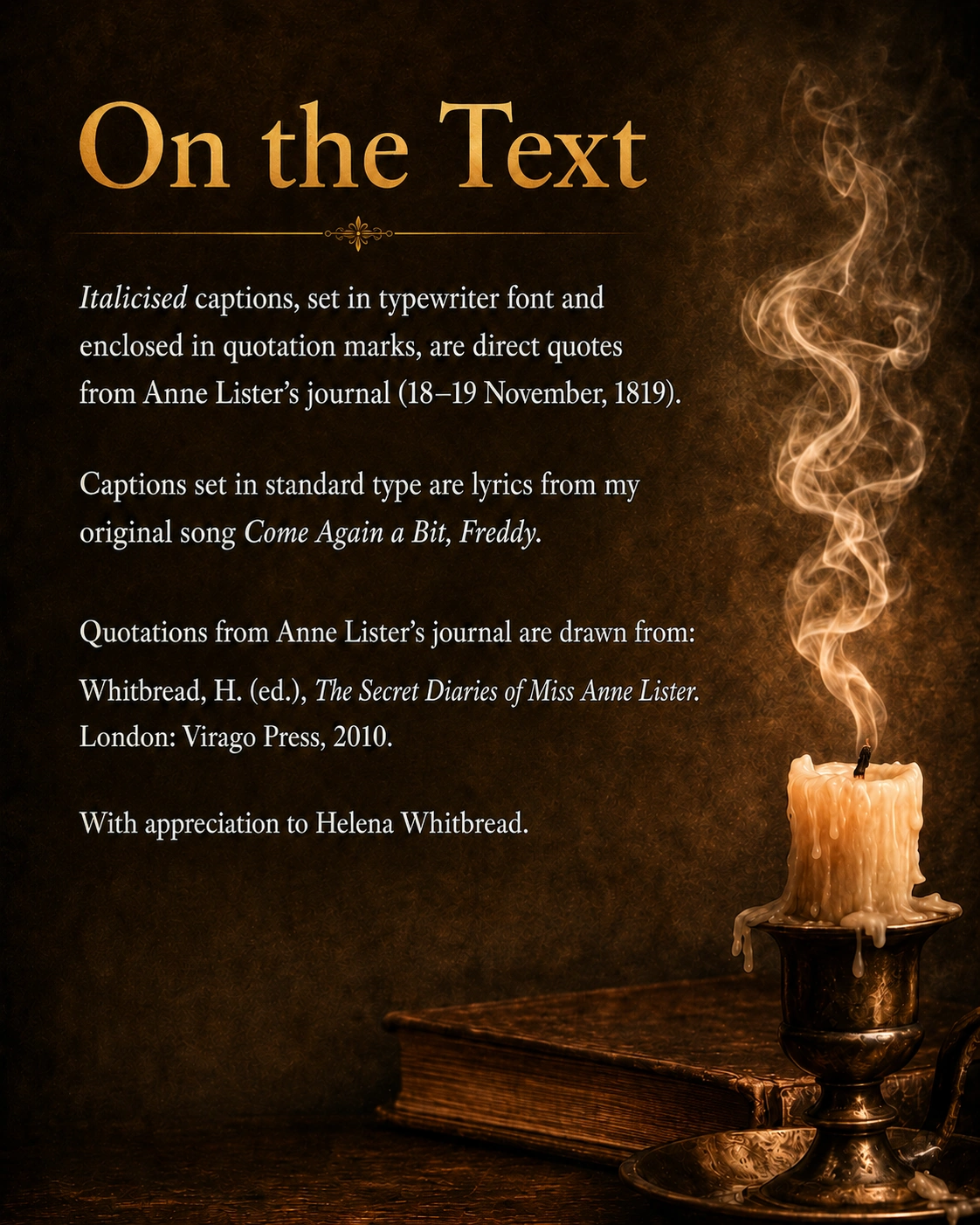
Before the Song World moves into close reading, this section sets out the key facts Lister records in her journal. The poster below organises Lister’s journal entry into five factual scenes:
1. The Journey to Manchester
2. Arrival in Manchester
3. Mariana and the Hair Incident
4. The Bed Scene
5. The Next Day: Shopping and Departure
This is an abbreviated factual sequence, not a full account of the entry.
A Close Reading of the Journal Entry
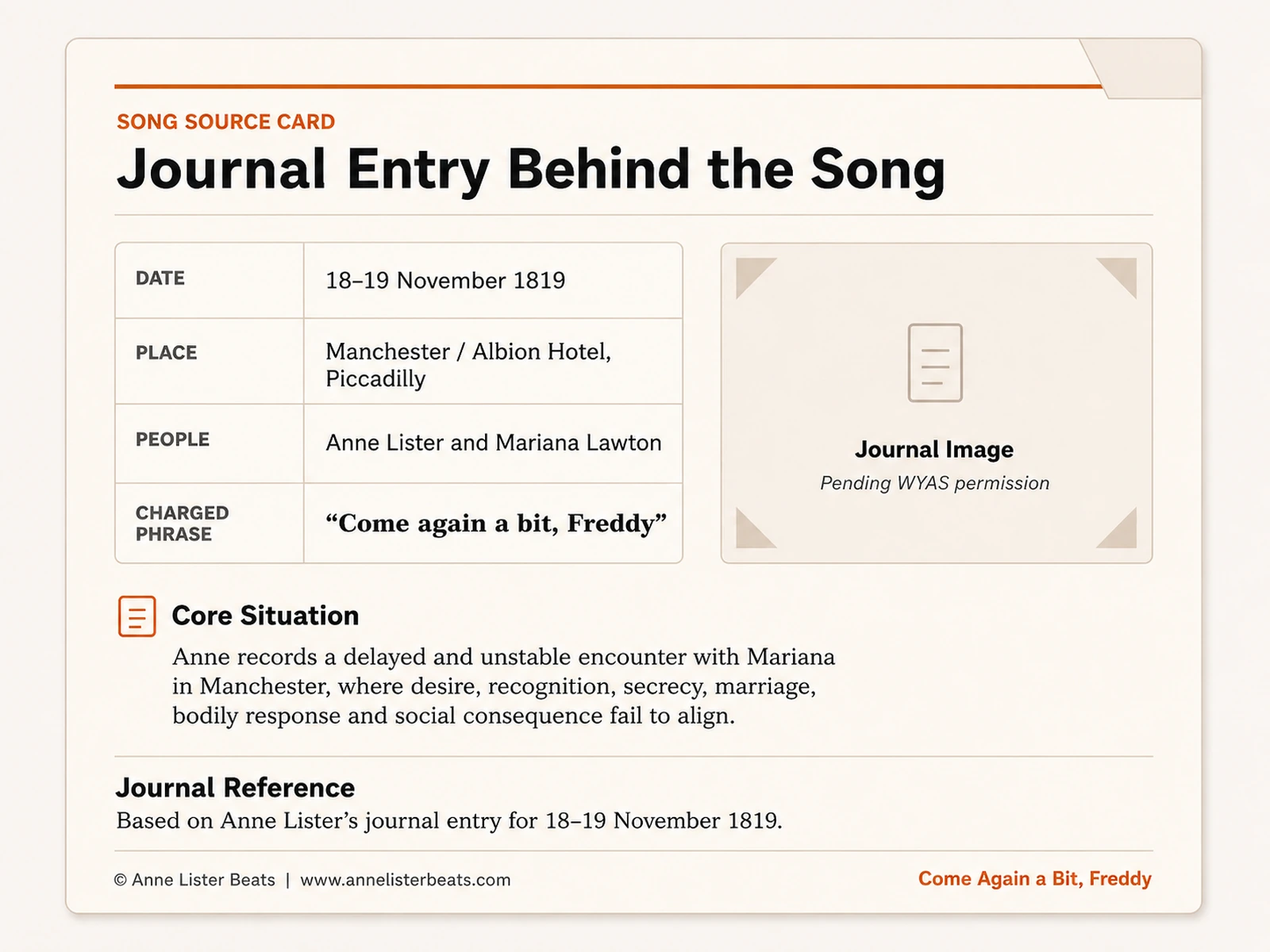
What follows is an analysis of Anne Lister’s journal entry recounting the “Come Again a Bit Freddy” incident.
1. Journey to Manchester: Opening Disjunction
The entry opens under delay, but not as a single interruption. It begins with a dual misalignment. Lister does not leave when intended, and once she does, movement is withheld again. She gets off later than planned (“Did not get off from here till a few minutes after 9”), only to wait a further ten minutes before the coach finally departs (“had to wait 10 minutes & the coach drove off”).
From the first line, intention fails to coincide with event not once, but twice. Readiness does not produce departure, and departure does not produce movement. The journey begins under a structure in which timing does not align with itself.
Spatial orientation is similarly split. Within the first three lines, Lister marks her movement in relation to “our church” and then “the old church,” shifting from a point of belonging to one already distanced. She situates departure through place rather than abstract time, fixing movement to location as well as schedule. But location does not stabilise the scene: it divides it.
So, departure is anchored twice, yet the two references do not coincide. The entry thus opens in a space-time that does not align with itself: delay is doubled, and position is split between belonging and removal. Before the encounter with the beloved (Mariana), the coordinates of movement already fail to coincide. Before desire fails (as we’ll see later), time and space already have.
This structural oddity is not incidental. It establishes a pattern in which progress toward the meeting with Mariana cannot proceed cleanly. Movement is staggered, deferred, and interrupted at the point it should begin. The effect is exact. The encounter is not approached directly; it is entered through a delay that repeats even at the moment of departure. The journey does not carry the subject forward in a continuous line; it advances in broken increments.
Once en route to Manchester, Lister soon shifts position. She leaves the interior of the coach and takes the outside seat behind the coachman, placing herself next to a blind fiddler and later a blind flute player. This movement exchanges enclosure for exposure and establishes a vantage point that is elevated, visible, and deliberately chosen: a position of oversight. She removes herself from the protected interior and situates herself at the edge of the vehicle, aligned not with passengers but with those who produce the journey’s sound.
The configuration is striking. Lister occupies the only position of sight among figures defined by its absence. The journey is accompanied by music produced without vision, while she observes both landscape and performers. Perception is distributed unevenly from the outset: sound continues without sight; sight presides without interruption. The scene is tuned before the meeting with Mariana occurs, and visual certainty is quietly destabilised before it is required.
The journey itself is not passed over. It is extended. Instead of a single movement from departure to arrival, it is broken into small, discrete units: the specific conveyance, the payment of sixpence for a seat, the arrangement of bodies, the sequence of motion. These details do not advance the encounter. They hold it back. Time is thickened before contact.
This produces a disproportion. The approach is lengthened beyond necessity, while the meeting remains deferred. Arrival does not follow naturally from departure; it is delayed, prepared, and made structurally difficult. The encounter is established not as an event that is reached, but as one that must first be held off.
2. Arrival in Manchester: Pre-Contact Misalignment
Arrival in Manchester does not resolve the delay established in the journey. It extends it. Entry into the city produces further displacement rather than contact. Movement toward the meeting with Mariana remains misaligned with itself.
Lister’s first act on arrival is not encounter but preparation. She halts at the Mosley Arms and subjects herself to a prolonged interval of washing and adjustment (“Had a thorough washing and brushing”). Time is taken, not saved. Arrival inserts a pause in which the body is recalibrated before it becomes visible to the other. The meeting is deferred once more.
Instead of proceeding directly to the Albion Hotel, Lister breaks the expected line of arrival. Her detour to St. Peter’s Field extends this displacement and positions the encounter under the shadow of the law before it begins. Lister physically walks the grounds of a recent state-sanctioned massacre (“Peterloo”). This is not merely a topographical curiosity, but a search for a site of tension. She traverses a landscape of violent legality in order to reach her own private landscape of desire.
Strikingly, Lister’s record of her visit to the site of the massacre remains coolly matter-of-fact and is unsettling. The entry registers the site dispassionately, almost as an object of inspection, and this detachment mirrors the delayed, displaced quality of her own arrival. The meeting with Mariana does not emerge from a neutral world, but from one in which exposure carries consequence.
By the time the two women come together, their illicit relation is already framed within a world of law, violence and regulation. Lister positions her personal “criminality”, as the text later defines her connection with Mariana, against the backdrop of violent legality; the state’s ability to make violence lawful.
At the Albion, misalignment persists. The interior fails to anchor the scene. Lister cannot remain in place. She sits briefly, then leaves again. The room does not hold her. The meeting is not yet possible because Lister does not remain where it is meant to occur.
By the time Mariana finally appears, the encounter has already been delayed and displaced. Arrival has not produced coincidence. It has multiplied the conditions under which coincidence fails.
3. Meeting with Mariana and the Hair Incident: Perceptual Rupture
The delay continues even inside the room. Lister goes upstairs into Mrs Belcombe’s room, and Mariana does not immediately appear: “presently, tho’ it seemed an age, came M- & the rest.” The phrase matters because it turns delay into bodily experience. Time does not merely pass; it stretches. Before Mariana is seen, she is already being waited for.
The meeting begins with a failure that has already occurred. Lister records that the Belcombes passed the Mosley Arms at the very moment her coach stood at the door, yet “somehow missed” her as she was getting out. Physical proximity does not produce recognition. Presence dissolves into absence at the very point of contact.
This missed encounter is not corrected by the eventual meeting; rather, it establishes the terms under which the encounter proceeds. The two trajectories intersect in space but not in perception. Recognition fails before the meeting properly begins.
When the women finally meet, the scene does not stabilise into mutual recognition. It moves immediately into uncertainty. The encounter is carried into a dimly lit interior where perception is already compromised. What should confirm presence instead introduces doubt.
The pivot comes with the hair incident. Lister removes her hat; her hair remains in curling papers. In the firelight, Mariana misreads what she sees and takes it for a drastic cutting of the hair: “the firelight did not let M- see my hair was in paper.” The reaction is immediate and disproportionate: she starts back “in horror.” A minor visual misreading produces a response of shock.
This misreading is sharpened by what precedes it. Lister has already spent nearly an hour en toilette, in preparation at the Moseley Arms, yet arrives with the apparatus of that preparation still in place. The labour of presentation does not produce a finished image; it produces the conditions for its distortion. And a process that should have remained private is exposed.
The moment exposes the fragility of recognition itself. Mariana does not respond to Lister as she is, but to what she appears to be under altered conditions. The beloved becomes briefly unrecognisable. Seeing fails to secure knowing.
Lister does not absorb Mariana’s reaction as an injury. She records that it “had done me a great deal of good” and that it “cured” her. The disturbance is not denied but recoded as remedy. What presents as shock is taken up as treatment. The moment is converted from wound into correction.
The conversion is decisive. Recognition fails, but the failure is appropriated rather than repaired. The meeting does not stabilise: it is managed. Seeing does not coincide with knowing, and the gap is not closed but used.
4. The Bed Scene: Failed Coincidence
The bed scene is already enclosed before it begins. Mariana’s time is not simply available; it has been permitted, measured and bounded. Charles has allowed the journey: “made no objection”, hurried the party away early so that Mariana might have more time with Anne, and given her until eight o’clock to be home the next day. The encounter takes place under temporal surveillance. Charles does not need to be in the room for his authority to structure it. The clock carries him there. This makes Anne’s later distress over Mariana as “another man’s wife” more than retrospective moral anxiety.
The bed scene does not begin with intimacy. It begins in disturbance. Before contact settles, the scene is already structured by agitation, classification and consequence.
Lister records that “The tears rushed to my eyes.” The body speaks first. But even as this happens, she asserts knowledge: she “felt I know not what” was passing within her, and immediately refuses its interpretation. The tears are not allowed to signify. They are explicitly denied their expected meaning: “They were not tears of adoration.” Feeling appears and is corrected in the same movement. The scene opens with affect that cannot stabilise into meaning, and is not permitted to do so.
At the same time, the relation is recast. Lister’s words “I felt that she was another man’s wife.” enter before the encounter settles into contact. Mariana is not only the woman in the bed; she is already positioned within an external structure. The introduction of divorce extends this further. The scene is immediately saturated with consequence. Intimacy is not entered in innocence. It is framed, from the outset, by a relation that exceeds it.
Only after this does the encounter proceed. And when it does, it does not resolve these pressures. It absorbs them. Lister “pretended sleep.” This is not the beginning but a response to what has already been established. She remains in the scene while withdrawing from it. The body is present; the subject withholds. Contact is permitted, but not owned.
This produces a split within the encounter. One part of the scene moves forward — touch, proximity, continuation — while another refuses to coincide with it. Participation and distance are held together. The moment is lived and displaced.
The name “Freddy,” Mariana’s pet name for Anne, enters the scene as a functional displacement rather than a simple term of affection. Mariana does not address Lister as herself, but under another name. Identity is not confirmed at the point of intimacy: it is loosened. The scene is sustained through a name that allows it to occur without fixing who is present within it. The bed becomes a field in which identity is adjusted to manage imbalance.
By accepting the name “Freddy,” Lister establishes a usable position: one that lets the encounter continue while she remains partially withdrawn, pretending sleep. The body proceeds; the subject does not fully coincide with it.
At the same time, the body asserts what the language refuses. Lister records that no one has given her kisses like Mariana’s: “& I told her no one had ever given me kisses like hers.” The experience is marked as singular, but it does not settle the scene. It stands alongside the earlier denial of feeling and the prior classification of the relation. Lister’s use of “kisses” carries a known euphemistic charge in her writing, so the word does more than name affection.
The language hardens further. The relation is recoded in terms that reduce Mariana to a position within exchange. Lister’s phrase “legal prostitution” marks the shift with full force. Elsewhere, Lister names “the criminality of our connection,” briefly placing the relation under a shared condition of transgression. But the symmetry does not hold. What is named as mutual is immediately recast as unequal, as Mariana is fixed within law while Lister remains its illicit supplement.
This is not an aside; it is a decisive reclassification. The beloved is transformed into a category. But the move does not produce distance. It implicates the one who makes it. The speaker remains within what she judges. The attempt to stabilise the scene through classification instead exposes its instability.
As this occurs, the field expands. Sarah Binns enters, not as presence but as invention, Anne’s fictive mistress introduced into the scene. A third is installed within the relation. The scene is no longer confined to the two bodies in the bed. It is extended, displaced, and multiplied.
The introduction of Binns does not simply add another figure; it redistributes position. The mistress now has a mistress. The structure folds back on itself, preventing Lister from being fixed as a mere supplement to Mariana’s legal bond. It cannot be held in a single form. Lister’s audacity is functional: she invents a third to avoid being trapped in the two. The mistress participates in exchange, but not in the same legal form Lister is attacking.
The refusal of a promise completes the structure. Closure is withheld. The encounter is not resolved into commitment, nor is it abandoned. It remains open because it cannot be stabilised. Nothing in the scene settles into a form that would allow it to conclude.
What remains is not a unified experience but a sequence of non-coincidences: feeling without meaning, contact without reciprocity, identity without fixity, intimacy without containment. The relation is narrowed through classification and widened through invention, and cannot be held in a single form. The encounter proceeds, but at no point does it fully coincide with itself.
5. The Next Day: Shopping and Displacement Without Resolution
Morning does not resolve the scene. It translates it. What cannot stabilise in the bed is carried outward into another register, where the same instabilities persist under different forms. The encounter does not close: it disperses.
The shift is immediate. The scene moves from the enclosed space of the bedroom into the public circulation of the city. But this is not a return to neutrality. It is a change of medium. This shift translates the instabilities of the bed into a legible register of cost. What could not hold as a relation reappears as an imbalance of payment. The relation continues, not through bodies, but through objects, purchases and exchanges.
Lister records the shopping in St Anne’s Square with striking precision. Flowers are noticed, requested, given. A clasp for a coral necklace (“meant for M- or Miss Browne”) is chosen from Oliphant’s. A book, The Pleasures of Hope, intended for Miss Browne, is offered to Mariana. Objects do not simply appear; they move between intended recipients. What was meant for one is offered to another. The relation is redistributed across things.
The movement of money sharpens this further. Lister notes the cost, the imbalance and the fact that she pays where she should not: “could ill afford”. The encounter is translated into expenditure. What had been described in terms of intimacy and classification now takes on the form of transaction, a financial cost.
In parallel, the structure of non-coincidence persists. The objects do not fix the relation any more than the body did. They circulate without resolving the positions they are meant to support. Giving does not secure attachment. Selection does not clarify intention. The scene continues to operate under misalignment, now displaced into material form.
The refusal of a promise remains in force. The conversation does not produce commitment. It produces withholding. Lister declines to stabilise the relation under a future bond. The encounter is left open, not as possibility but as non-resolution. Nothing is secured because nothing has held together strongly enough to be secured.
The departure confirms this. The return journey is stripped of the earlier dawdling. The sensory detail and the extended approach all disappear. Movement becomes efficient. The seven-hour ordeal of the arrival is replaced by a prompt, efficient transit. Lister records spending “Only 10 minutes changing horses at Rochdale” and getting home “after a good journey”. The scene no longer requires deferral because it no longer leads toward anything to be held off. The encounter is behind her, but not resolved.
This compression is not incidental. It marks a shift in function. The outward journey stretched time to delay contact. The return collapses time because there is no longer anything to approach. The encounter has occurred, but it has not produced coherence. There is nothing left to sustain.
Her final remark about Manchester and the Albion Hotel is not casual. It reduces the scene to a domain in which judgement holds. Noting that despite the Albion Hotel being regarded as “the 1st or genteelest house in Manchester” they had “bad eatables or cooking” is balanced, controlled and unambiguous. It marks Lister’s re-entry into a legible world.
What remains is circulation without settlement: objects exchanged, money spent, promises withheld, movement resumed. The scene disperses across the city and then withdraws from it, leaving no stable form behind.
The sequence ends where it began, in movement, but without alignment. The encounter has taken place, but it has not held together.
6. What the Song Takes From the Journal Entry
This is the pressure the song inherits. The journal entry and the song are joined by the same charged phrase: “Come again a bit, Freddy.” Both return to the same scene of desire and failed alignment: the journal records it; the song tries to sing it into shape.
The song keeps trying to resolve the encounter into romance: a “perfect match”, “two sparks colliding”, a return to touch, possession and private recognition. It wants the scene to become continuous, mutual and sustained.
But the song also knows that this resolution cannot fully stabilise. “Forever slipped between the bedclothes”; “we lost the sun beyond the curtains”; “in the night, we lost our way.” The love song keeps forming and unforming at the same time.
That is where the song remains closest to the journal entry. Both are driven by desire, but neither arrives at a clean alignment. The encounter proceeds, repeats and returns, but it never fully coincides with itself.
The Song

Listen
Lyrics
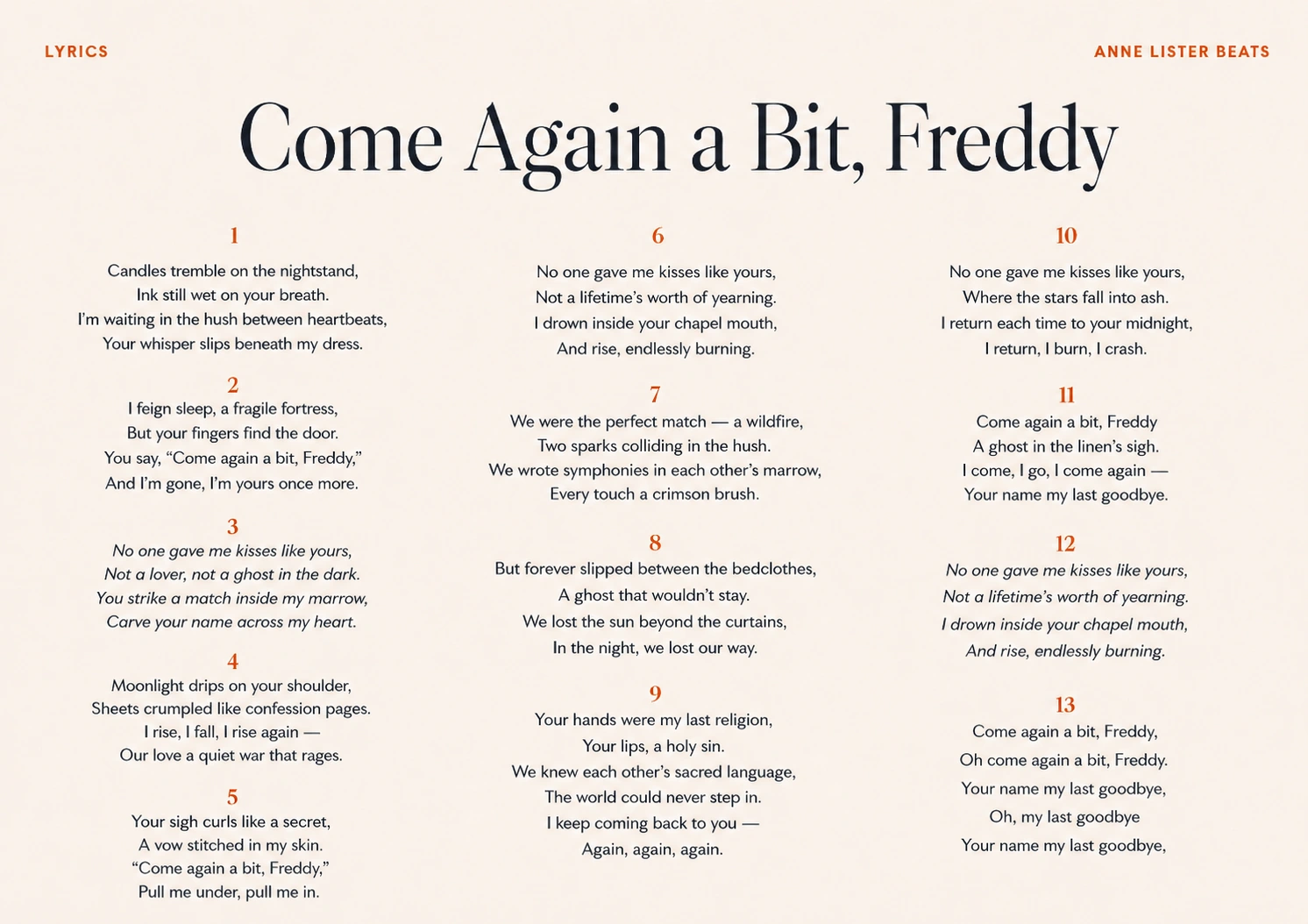
For those who, like Anne, wish to examine the text with proper attention.
SongScape
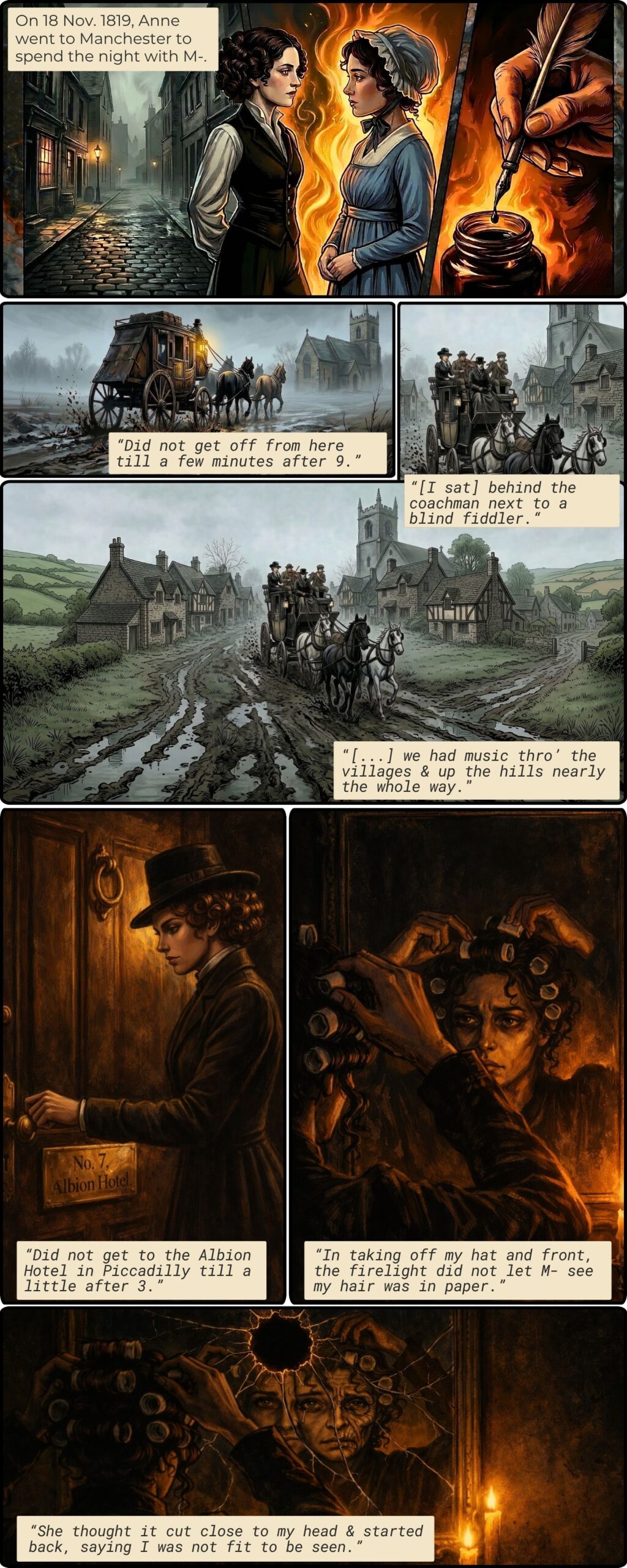
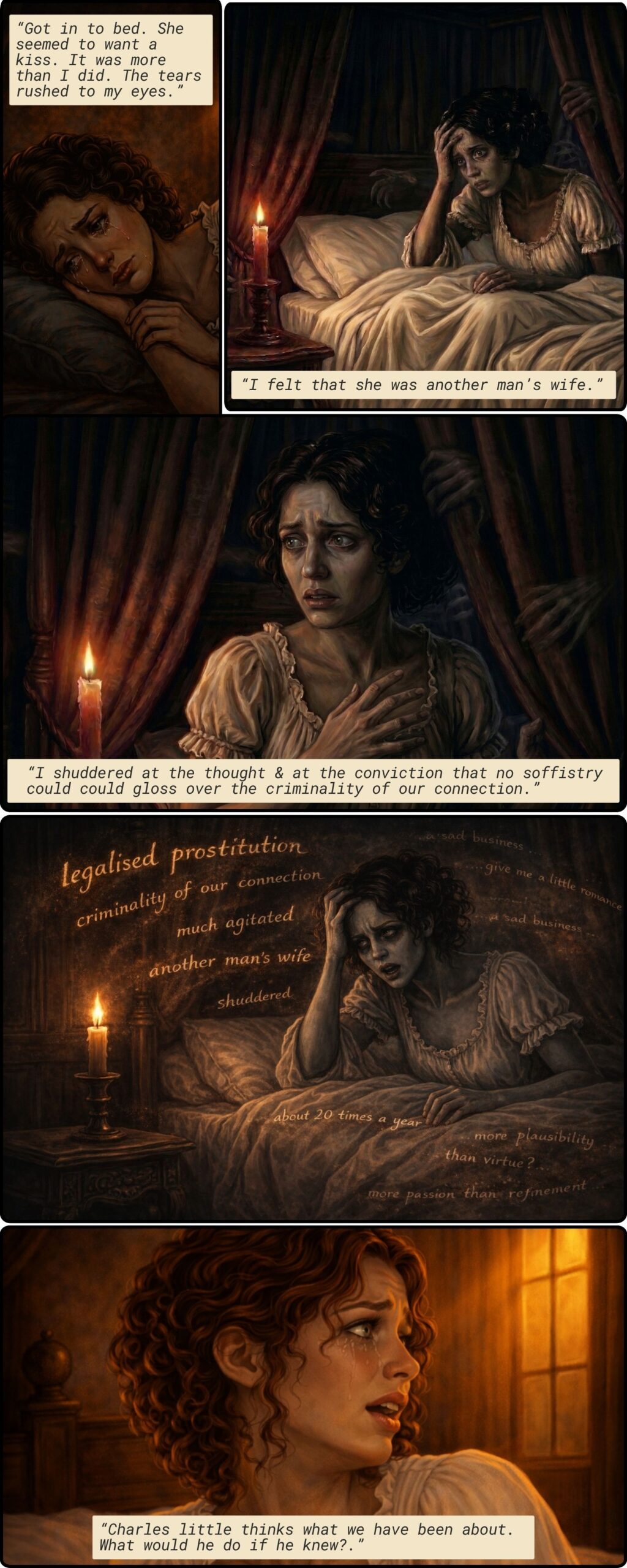
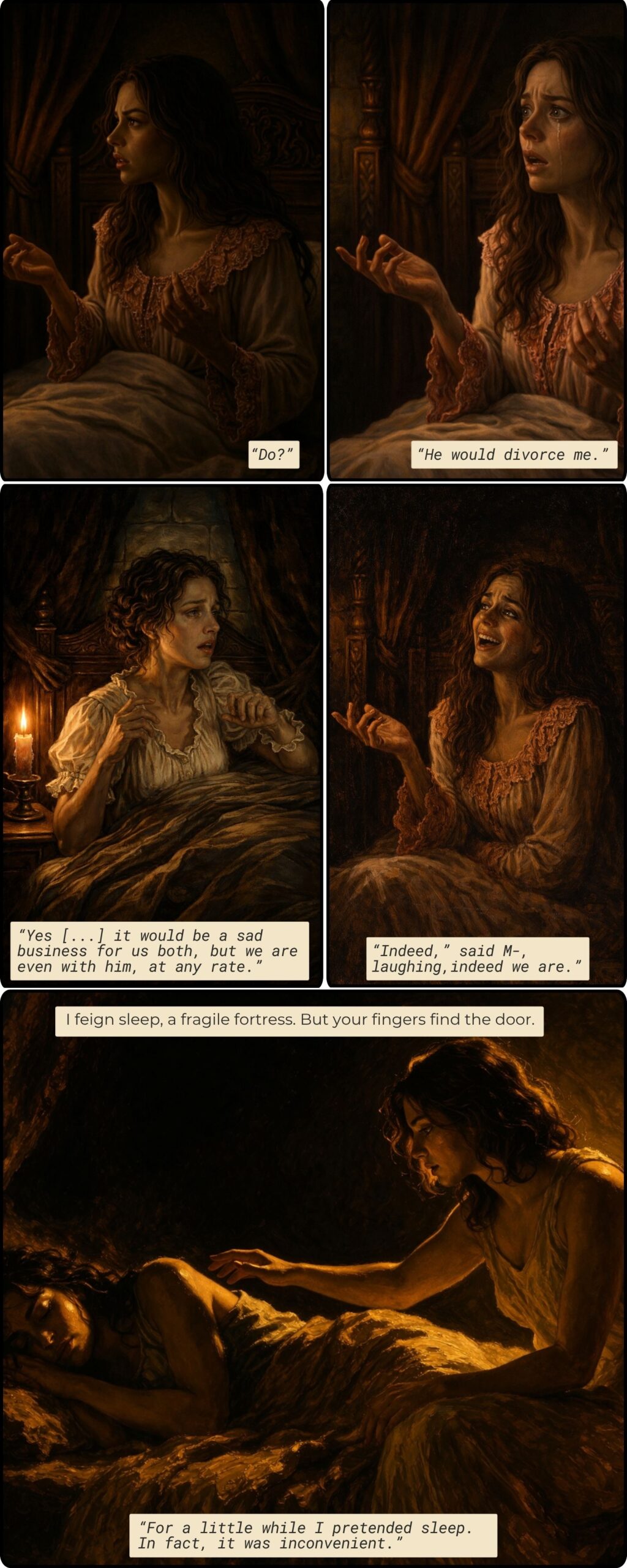
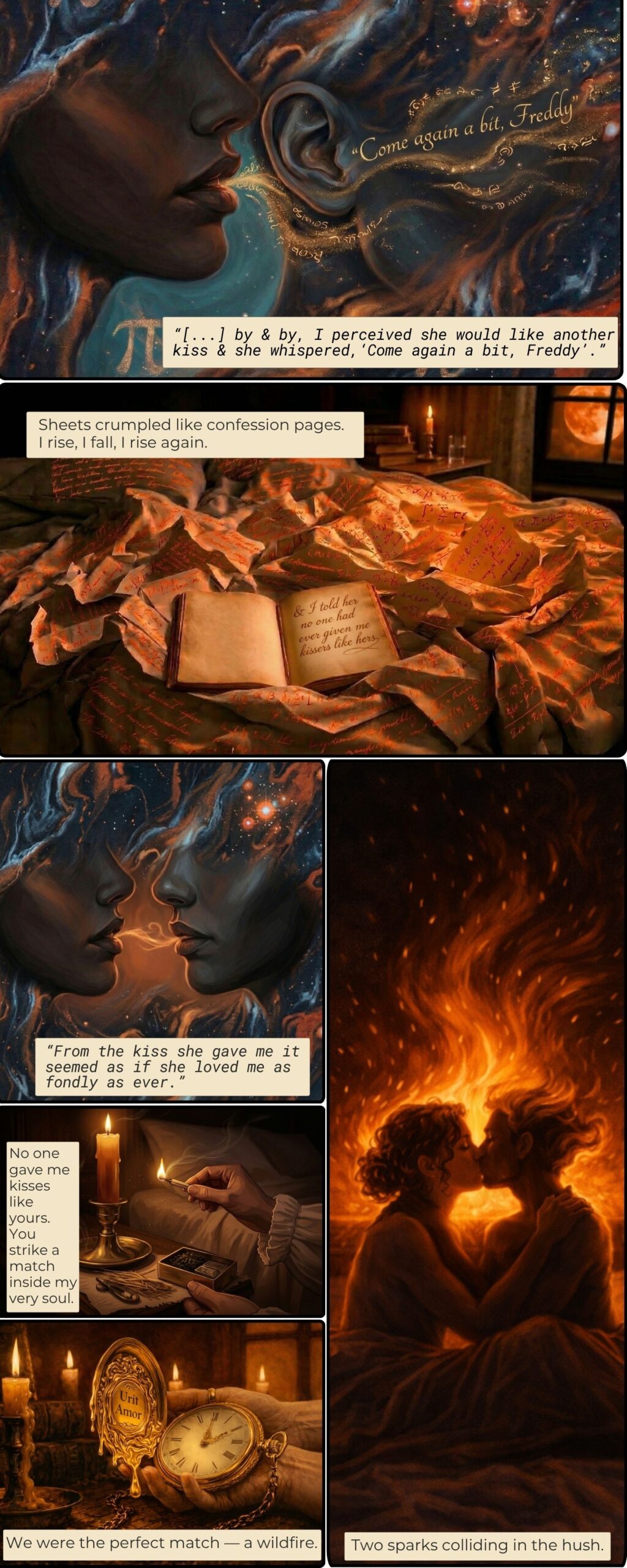
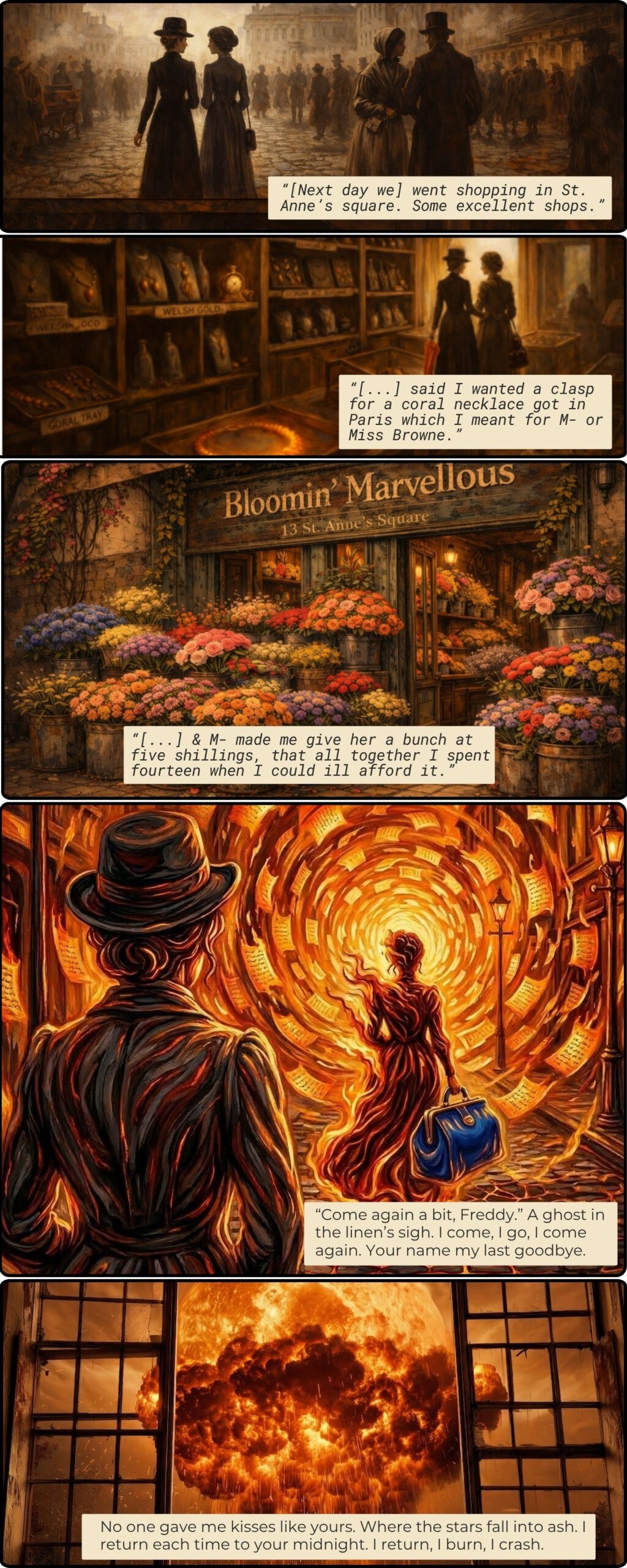
The SongScape turns the song’s unstable love-story into a visual sequence. It does not illustrate the journal entry scene by scene. It follows the pressure created when desire tries to become romance, but cannot fully settle into one shape.
The song reaches for intensity, return and possession: “I’m gone, I’m yours once more”, “the perfect match”, “I keep coming back to you”. But that romance keeps breaking: “Forever slipped between the bedclothes”; “we lost the sun beyond the curtains”; “in the night, we lost our way.”
The images hold that double movement: closeness and fracture, repetition and loss, fire and shadow. This is not a resolved love story. It is a visual rendering of a song trying to make unstable material glow.

Song Video
Anne Lister's Places and Context
Manchester
The Albion Hotel, Piccadilly, Manchester
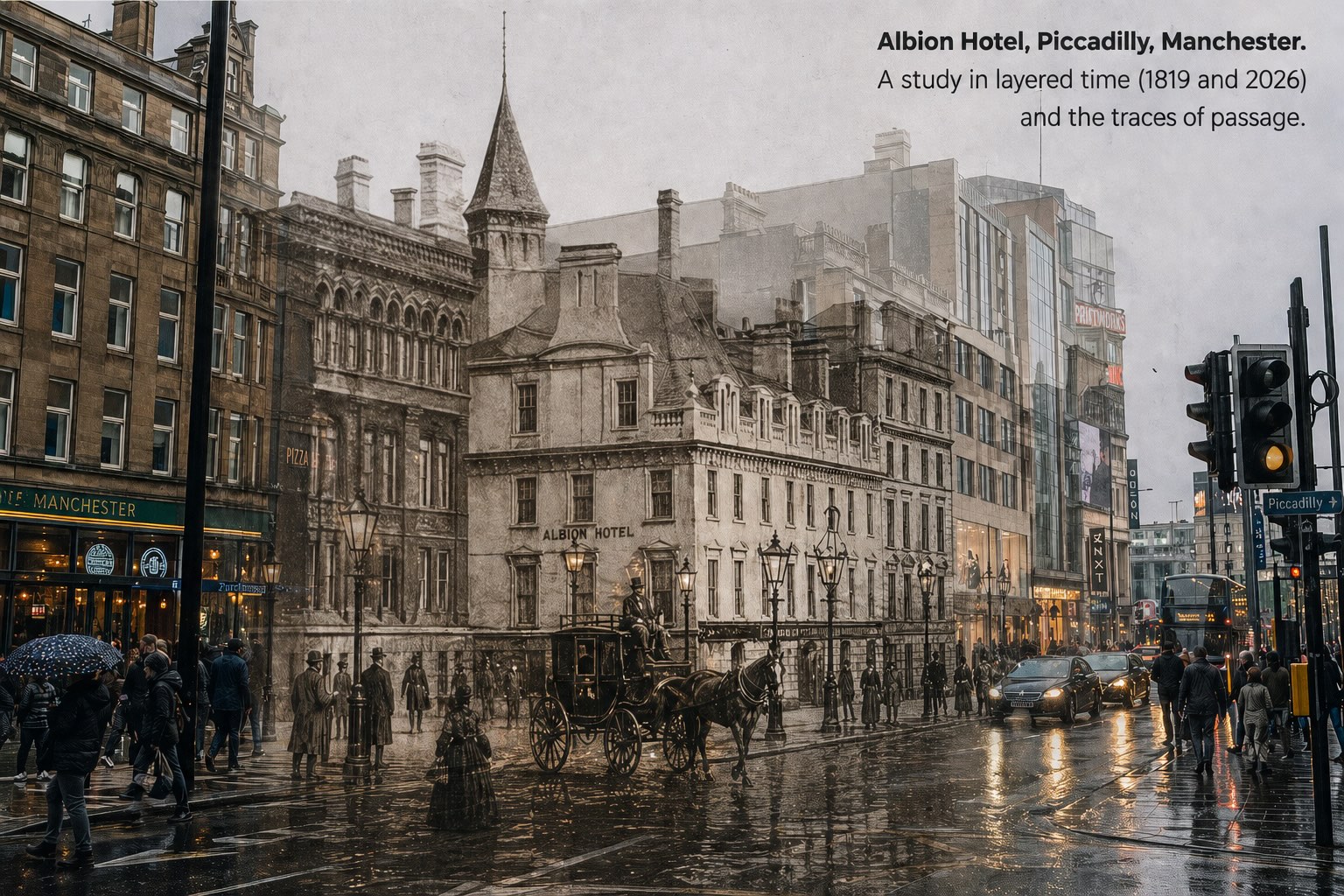
The Albion Hotel in Piccadilly was not simply a place to stay. It was a principal coaching hotel in early nineteenth-century Manchester, part of the infrastructure that received, held, and dispersed travellers moving through the city. Its function was transitional. Coaches arrived, passengers waited, connections were missed or remade, and movement resumed. It was a site organised around passage rather than settlement, where timing mattered yet coincidence was never guaranteed.
This matters for this Come Again a Bit, Freddy entry because the structure of the place mirrors the structure of the scene. Anne’s arrival is marked by delay and mis-timing: a late departure, waiting for the coach, missing the Belcombes on arrival, time spent in suspension before contact is established. None of this is unusual in itself. But within the logic of The Albion, these are not anomalies. They are the ordinary conditions of a space designed for circulation. Encounters occur there, but they do not stabilise easily. They depend on timing, and timing is unreliable.
The meeting with Mariana therefore takes place within a setting already predisposed to non-coincidence. The hotel does not anchor the encounter; it prolongs its instability. People pass through, overlap imperfectly, and move on. The space does not produce fixed relations, but temporary alignments that can fail at any point. What happens between Anne and Mariana is intensified by this, but not caused by it. The conditions of delay and misalignment are already in place before the encounter begins.
Demolished in 1928 and replaced by a Woolworth’s store, the site remained given over to circulation and exchange. For historical images of the building and its dining rooms see manchesterhistory.net.6
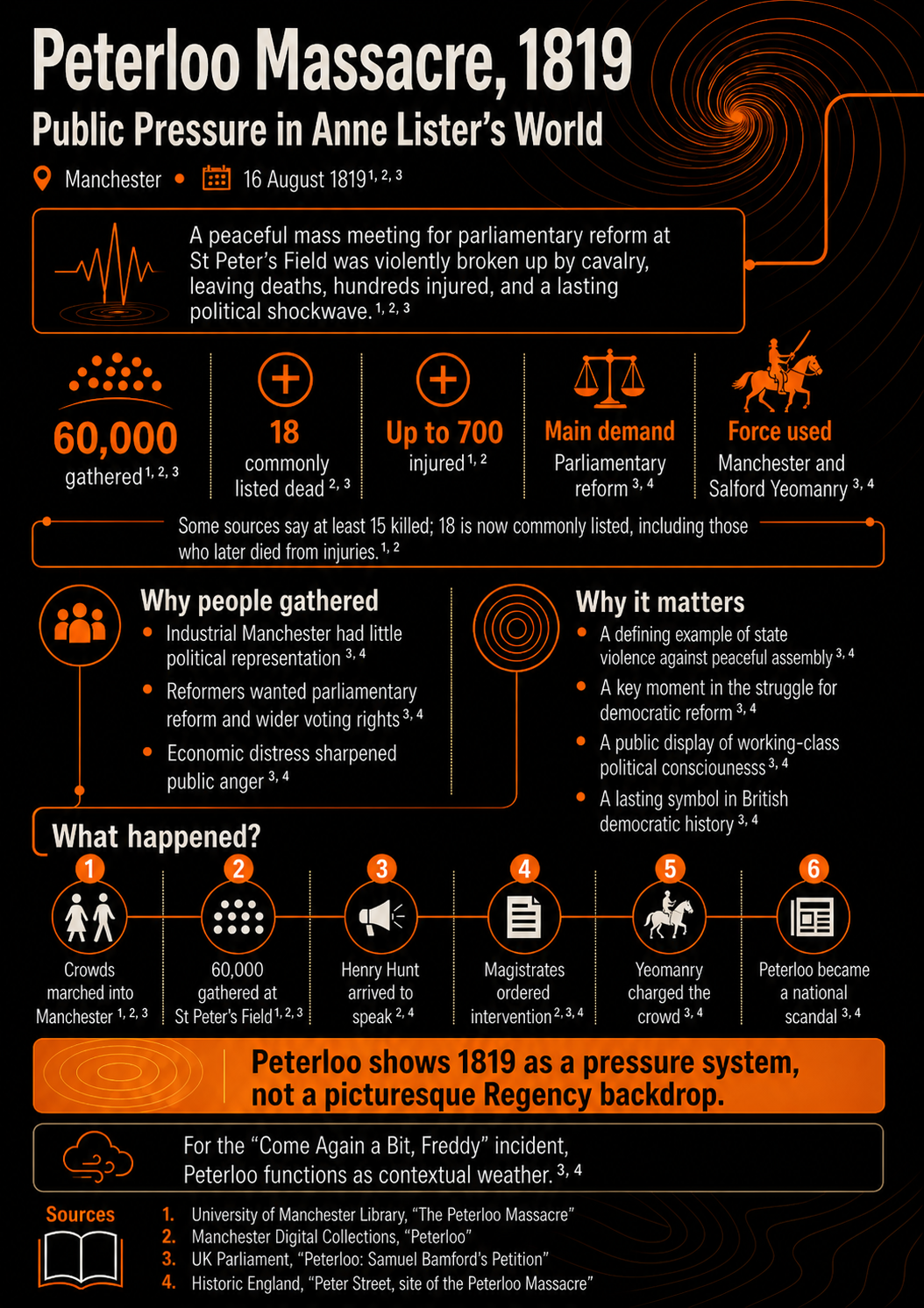
1819 Context: Peterloo as Public Pressure
Peterloo is included here as contextual weather for Anne Lister’s 1819 world. It shows the public pressure of the year: reform, fear, class tension, state violence and the demand to be heard.
From Anne Lister's Journal
Why This Summary?
This summary fixes the ground. It sets out what Anne records in sequence, without interpretation or judgement. Everything that follows remains accountable to the text.
It also provides orientation. Anne’s material is dense; a clear outline stabilises time, action, and position. What is established here allows the analysis that follows to show where alignment fails, and where the song moves differently.
This is not a reconstruction of what happened, but of what is written. The account is already shaped, active, and under pressure.
Structure of the Entry
The material for 18 and 19 November 1819 falls into five scenes:
- Journey to Manchester
- Arrival in Manchester
- Meeting with Mariana and the Hair Incident
- The Bed Scene
- The Next Day: Shopping
1. Journey to Manchester
- Did not leave until a few minutes after 9:00 by “our church”
- Had to wait a further 10 minutes; the coach drove off at about 9:30 by the “old church”
- Took the outside seat behind the coachman, next to a blind fiddler (paid 6d.)
- A gentleman exchanged places with her
- A blind flute player was also present (the fiddler’s companion)
- Music was played through the villages and up the hills for most of the journey
2. Arrival in Manchester
- Arrived in Manchester and stopped at the Moseley Arms at about 2:15 p.m.
- Had boots cleaned; undertook a thorough wash and brush (“took near an hour”)
- Moved to the Albion Hotel, Piccadilly, shortly after 3:00 p.m.
- The Belcombes had arrived about an hour earlier
- Anne and William Milne (Mariana’s sister and nephew) had just gone out; dinner was not ordered until 5:30 p.m.
- Called for a newspaper and read briefly
- Sent for someone to show her Petersfield and its environs
3. Meeting with Mariana and the Hair Incident
- Went out at 3:30 p.m. and returned after 45 minutes
- Went upstairs to Mrs Belcombe’s room
- Found Mariana there with the others
- Anne’s arrival had not been expected; Mariana had given up on her
- Mariana received her with marked feeling and agitation but greeted her affectionately
- While dressing for dinner, removed her hat and front
- Hair was still in paper (curling papers), visible in the firelight
- Mariana reacted strongly (with “horror) on seeing them
- Said her hair had been cut too close
- Said she was “not fit to be seen” and could not make it look decent
- Mariana’s sister was called to assist with the hair
- The matter was treated lightly
- She changed dress and went down
- Appeared composed and “looking the neatest of the party”
4. The Bed Scene
- Little conversation before going to bed
- Charles had allowed Mariana to come to Manchester and had hurried her away early
Discussion of Mariana’s marriage
- Anne asked how often Mariana and her husband were “connected” (about twenty times a year)
Bed scene
- Mariana sought a kiss; Anne was less inclined
- Anne became agitated; tears came to her eyes
- Said the tears “were not tears of adoration”
- Mariana did not understand her state
Statements about the relationship
- Anne felt that Mariana was “another man’s wife”
- Reflected on “the criminality of our connection”
- Believed this had not occurred to Mariana
Conversation about consequences
- Mariana said Charles did not know what had passed
- Asked what he would do if he knew
- Anne replied: “He would divorce me.”
- Thinks Mariana treated this lightly
Further remarks about marriage
- Reflects that Mariana’s marriage is “legal prostitution”
- Suggested romance as justification
“Come again a bit, Freddy”
- Mariana gave Anne a kiss and was affectionate
- They seemed to fall asleep
- Mariana seemed to want another kiss and whispered: “Come again a bit, Freddy.”
- Anne pretended to sleep but then she complied
- Told Mariana that no one had ever given her kisses like Mariana’s
Discussion of promises and attachment
- Talked of past and present commitments
- Mariana suggested Anne might make another promise
- Anne refused
- Mentioned Tib and earlier expectations
- Anne stated she was at liberty and not bound to Mariana
- Mariana accepted this and appeared pleased
- Anne stated she did not feel, and could not feel, love toward Tib
5. The Next Day
Shopping
- Went shopping in St Anne’s Square
- Nantz (Mariana’s sister) chose a bunch of flowers
- Nantz had “no silver”; Anne paid for it
- Anne then bought a second bunch for Nantz
- Paid 9 shillings for the two bunches
- Spent 14 shillings in total, more than she could afford
Purchases and gifts
- At Oliphant’s, Anne considered a clasp for a coral necklace she bought in Paris
- The necklace had not yet been finally assigned; it might be gifted to Mariana or to Miss Browne
- Mariana chose the clasp she wanted for the necklace
- The clasp was to be made and sent later (estimated cost half a guinea)
- Anne then offered Mariana a choice: the coral necklace or a bound copy of The Pleasures of Hope
- Mariana chose the necklace
- Made two or three further shopping stops
Departure from Manchester
- Drove off from the Albion at 2:30 p.m.
- Described it as a genteel house with poor cooking and food
Return Journey
- Only 10 minutes changing horses at Rochdale
- Arrived home at about 8:15 p.m. after a good journey
Reading the Journal Entry
Anatomy of a Song
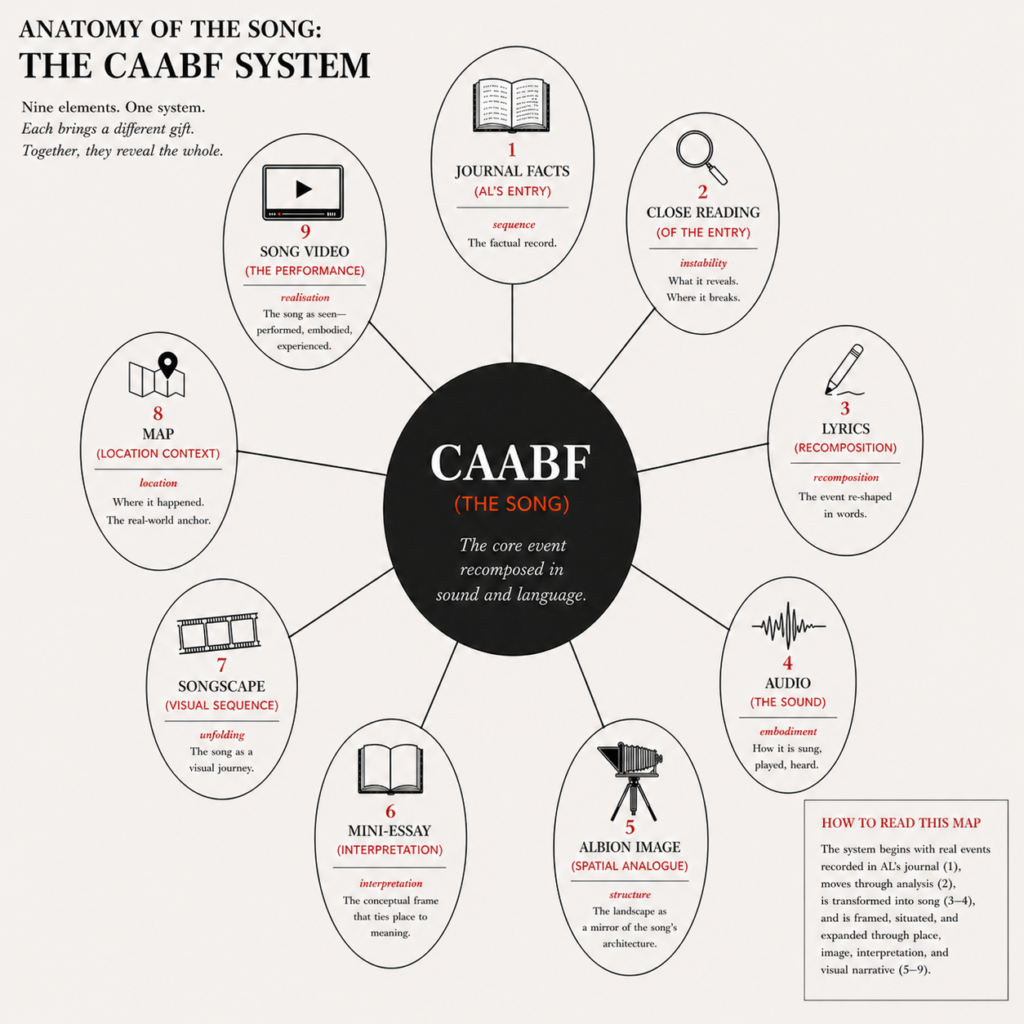
Anatomy of the Song: The CAABF System
CAABF is the abbreviated form of the title of the song Come Again a Bit, Freddy. What appears here is not decoration but structure: a map of how the piece is made.
The system begins with Anne Lister’s journal entry, moves through close reading, and is re-formed as lyrics and sound. From there, it expands outward through place, image, interpretation, and visual sequence, before arriving at the song as performed and experienced.
Each element does a different kind of work. The journal provides the sequence. The reading exposes instability. The lyrics reshape the event. The audio gives it body. The Albion Hotel image supplies structure. The essay frames it. The SongScape unfolds it. The map anchors it. The video realises it.
What the diagram shows is not a process in time but a set of relations. The song sits at the centre, but it is not self-sufficient. It is produced through these elements and, in turn, holds them together.
References
These sources support the historical, geographical and interpretive context behind Come Again a Bit, Freddy.
1. University of Manchester Library, “The Peterloo Massacre.” Source link. Accessed 5/4/26.
2. Manchester Digital Collections, “Peterloo.” Source link. Accessed 5/4/26.
3. UK Parliament, “Peterloo: Samuel Bamford’s Petition,” Petitions Committee, 17 April 2019. Source link. Accessed 5/4/26.
4. Historic England, “Peter Street, site of the Peterloo Massacre where the Free Trade Hall now stands, Manchester,” in “Ten Places that Uncover the History of Power, Protest and Progress Selected in Historic England Campaign,” published 7 August 2018. Source link. Accessed 5/4/26.
5. Whitbread, H. (ed.), The Secret Diaries of Miss Anne Lister. London: Virago Press, 2010.
6. Manchester History, “The Albion Hotel.” Source link. Accessed 12/5/26.