Carry Me Back to Yorkshire
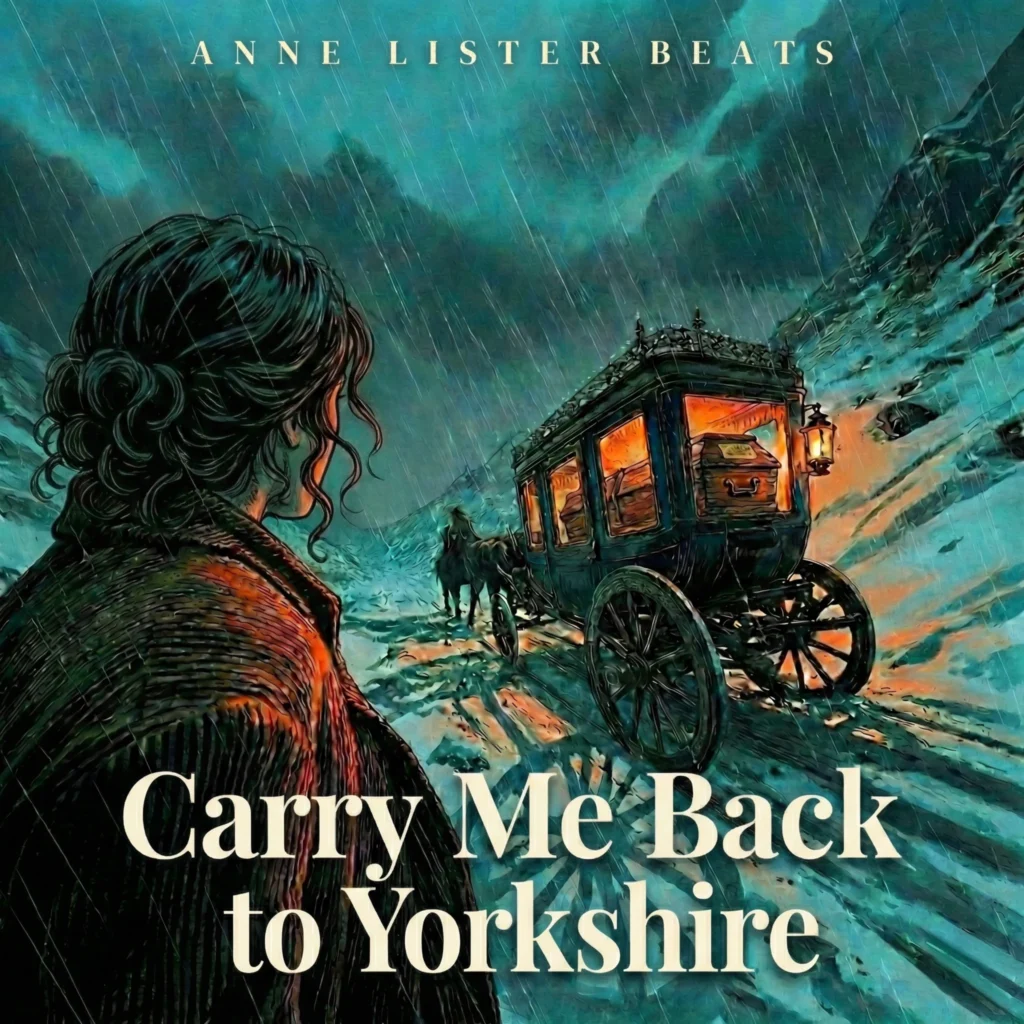
This song imagines Anne Lister’s spirit travelling home from Kutaisi across land and sea to Halifax. It is a lyrical interpretation of the verified 1840–1841 repatriation route. The map and timeline that follow further down describe the historical repatriation; the song traces a different, inner journey.
Carry Me Back to Yorkshire traces Anne Lister’s final, posthumous journey, spoken in her own imagined voice, as she is carried home from distant ground, Kutaisi, Georgia to the place that shaped her, Halifax, Yorkshire. The song holds to the quiet truth of her character — disciplined, reflective, unsentimental — and follows her through land and sea towards Halifax, the only place that ever claimed her fully. I created this piece to give that journey a sound-world. Not a dramatic retelling, but a steady, processional movement that mirrors the way her story returns always to Yorkshire. The aim was simple: to let listeners hear what history did not or could not record. Her return from Kutaisi left only fragments in the archive — a journey largely unspoken — so the song steps into that silence and gives that passage a voice.
Musically, the song sits inside an American narrative-folk idiom: a steady, travelling pulse with the feel of a train setting out, warm midrange instrumentation, and a storytelling vocal line. It isn’t an historical voice; it’s a contemporary folk voice (with an American twang!) carrying Anne Lister’s story forward. This is a homecoming, not an ending. It forms part of the wider project of opening her life through sound and image, not scholarship, thus bringing her closer through atmosphere rather than analysis.
This project positions Anne Lister as a narrative anchor, not a museum exhibit. Historical accuracy is not the governing principle. I’ve chosen visuals for their symbolic force, not period correctness. Please don’t be surprised, therefore, when you see Anne driving a vintage motorcar across the Yorkshire countryside and on into Halifax.
Listen
Lyrics
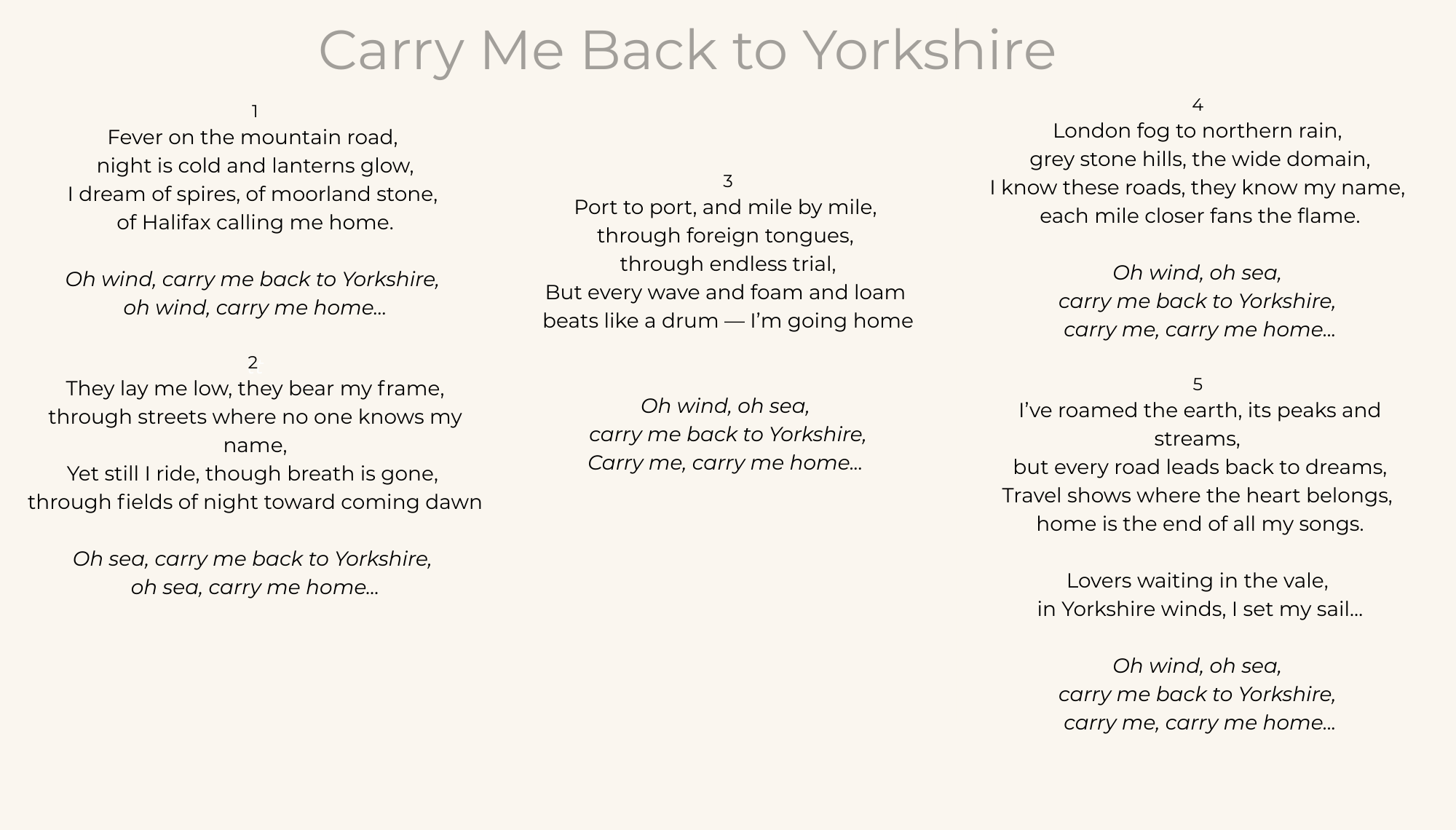
For those who, like Anne, wish to examine the text with proper attention.
SongScape
History might give us the dates but art gives us the feeling. This SongScape — visual sequence — conveys the spiritual and physical homecoming of Anne Lister as told by the lyrics of Carry Me Back to Yorkshire. We move from telling and hearing to showing and seeing.
I’ve opted for a graphic-novel aesthetic, which is heavy ink, high contrast, and a rich cyan/orange palette, to best capture the cinematic atmosphere of a journey (for both Anne and Ann) that was, surely, as dark as it was determined.
Through a series of sixteen stylised, graphic-novel panels, I trace the emotional arc of Anne’s return, from the fevered mountain roads of Georgia to the dark, foggy streets of London. Using a high-contrast chiaroscuro* style, these images evoke the biting cold of the Caucasus, the rough toss of the Black Sea, and the enduring resolve required to bring her back to the landscape that defined her. It is a visual poem, a visual elegy, about loyalty, grief and the magnetic pull of home.
* In laywoman’s terms, chiaroscuro is the dramatic use of light and shadow to create a sense of depth and volume in a flat image. The word comes from Italian: chiaro (clear/light) and oscuro (obscure/dark). Rather than using soft, even lighting, chiaroscuro relies on bright highlights right next to deep, dark shadows to make objects and people look three-dimensional and “pop” off the page.

Song Video
Anne Lister's Places and Context
Kutaisi, Georgia
Documented Route of Anne Lister's Remains
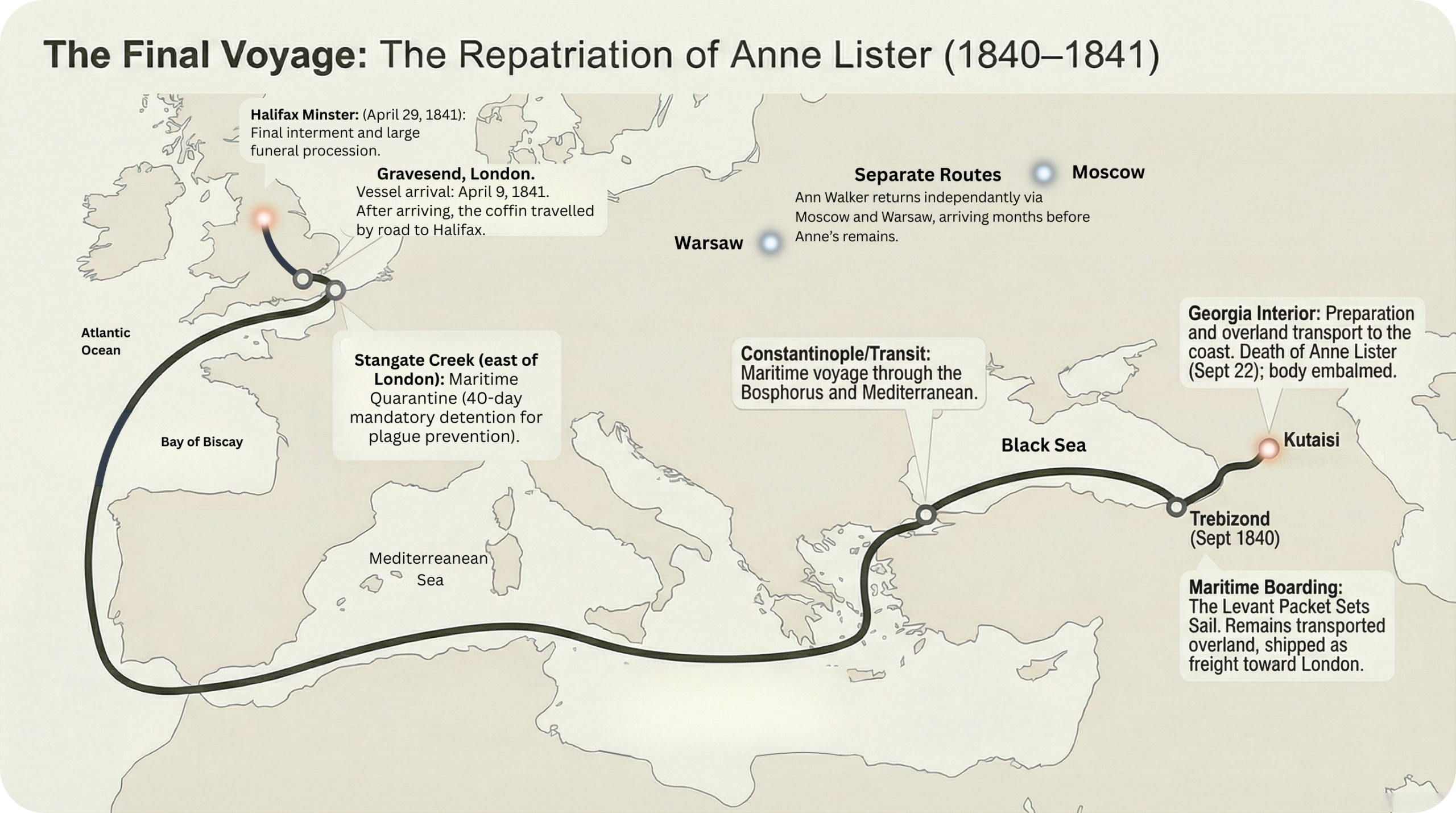
The visual below of Anne Lister’s last journey supplies the hard reality behind the sentiment of the song.
Carry Me Back to Yorkshire – It is a simple plea, but in 1840, it was a monumental undertaking. When Anne Lister died far from home in the foothills of the Caucasus mountains, returning her to the soil near Shibden Hall was an act of supreme devotion born of arduous logistics.
Following her death in Kutaisi, Georgia, in September 1840, it took 219 days to repatriate her remains. The infographic below details that posthumous voyage. It traces the initial overland trek out of Kutaisi in Georgia and then from the Black Sea port of Trebizond, across the Mediterranean, and through a mandatory, frustrating 40-day plague quarantine at Stangate Creek before she could finally be laid to rest in the family vault at Halifax Minster in April 1841.
Anatomy of a Song
The timeline and facts regarding Anne Lister’s repatriation are based on original research conducted by Steve Crabtree and Diane Halford, utilisng records from the National Archives and the West Yorkshire Archive Service. Reference: Steve Crabtree (2020) “Ann Walker’s Return to Shibden”: In Search of Ann Walker. Accessed 8 April 2026.